TouchPro A Touch Utility Integrated into Explorer | |||||||||||||||||||||||||||||||||||||||||||
TouchPro allows you to change any combination of file time attributes through a file's property pages. It fully integrates into Windows Explorer giving you the ability to affect the timestamps of:
The registered version of TouchPro enables extra facilities:
DownloadSupported Operating Systems - 32 (x86) & 64-bit (x64) versions
If you're using Windows 8 or Server 2012 see the Windows 8 items in our FAQ section.
|
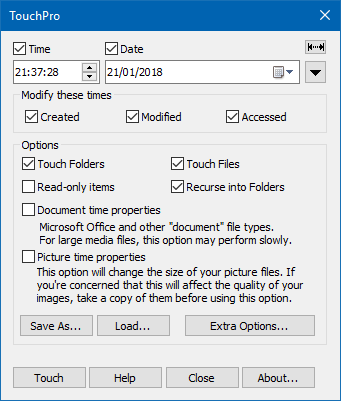
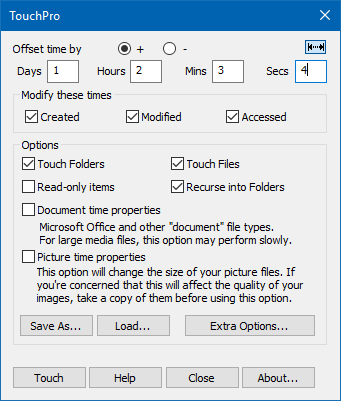
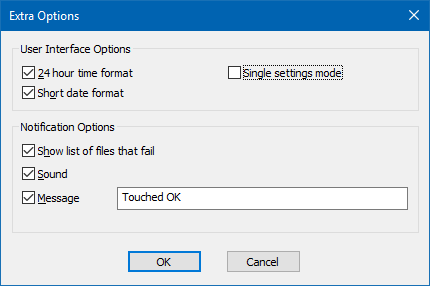
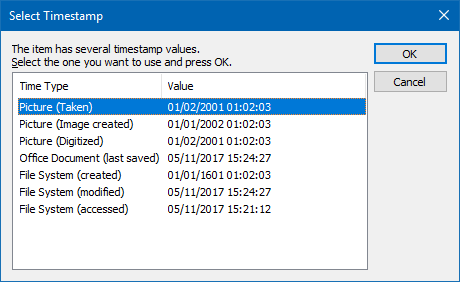
Screen Shots | ||||||||||||||||||||||||||||||||||||||||||
TouchCmd Scripting ExamplesThe following VB script examples show how you can use the command line version of TouchPro for operations that aren't possible from the GUI: 1. This example sets a directory's timestamp to that of the earliest file timestamp contained in the directory: SetFolderToEarliestFile.zip Use (from a command line): SetFolderToEarliestFile YourDirectoryName [r] The optional "r" flag makes the script operate in all nested sub-directories. 2. This example sets an Office document file timestamp to the same as its embedded timestamp: SetFileTimeToOfficeDocTime.zip Use (from a command line): SetFileTimeTofficeDocTime YourDocumentFileName 3. This example sets a picture file's modified time to be the same as the picture's "Date Taken" timestamp: SetFileTimeToPictureDateTakenTime.zip Use (from a command line): SetFileTimeToPictureDateTakenTime YourPictureFileName 4. This example sets a file's created time to be the same as it's modified time: SetCreatedToModified.zip Use (from a command line): SetCreatedToModified YourFileName 5. This example set's a file's created and modified time from a timestamp derived from its file name: SetFileTimeFromDateInFileName.zip e.g. For file with a name format of yyyyMMddhhmmss.ext (such as 20111225010203.ext), this script sets the timestamps to 25'th Dec 2011 01:02:03. You may need to edit this script to accommodate your specific file naming convention and your date time locale format. Repeating Scripts using the "for" CommandYou can further automate these scripts to perform their operation on multiple files or directories using the "For" command like this: for %F in (*.jpg) do <ScriptName> <parameters - use %F for the filename> You can do recursive directory processing like this: for /D /R <path> %F in (*) do <ScriptName> <parameters> for example: for /D /R .\ %F in (*) do SetFolderToEarliestFile.vbs %F ... to set each sub-directory timestamp to match that of the earliest file contained in that sub-directory. More information on the for command. Running Scripts from a custom Context Menu in Windows ExplorerIf you'd like to run a script from a context menu in Windows Explorer so that you just select a file or directory, right click and choose a command, you can add registry entries to create your own commands. Here's the contents of a .reg file that will add a context menu command to any directory to run the SetolderToEarliestFile script. (You will need to modify it for the location where you store the script file). Windows Registry Editor Version 5.00 If you'd prefer to change the registry manually, here's what you do.
Now when you right click any directory you'll see the new command. TranslationsTouchPro loads its UI components (dialog, tooltip strings, error messages) from a separate resource DLL (TouchPro.lang). By replacing this DLL with an equivalent one in a different language, the TouchPro GUI will display in that language. We don't have the resources to do comprehensive translation work, so we're opening this up to anyone who may want to do this for themselves using their own resource editing tools (such as Visual Studio or Resource Hacker) to edit the resource DLL. Currently we have the following non-English resource files available. Note: These translated resource files will only work correctly with the associated release of TouchPro.
To have TouchPro use a new language DLL:
You may need to log off/on for the new language to take effect. Translating the ResourcesStart from the supplied master English resource file TouchPro.lang (in the TouchPro installation directory - which is normally [SysDrive]:\Program Files\JD Design\TouchPro). Open this resource DLL with a tool that provides you with the facility to edit resource DLLs (such as MS Visual Studio). Items that need translating: 1. The TouchPro dialog texts - except for the dialog caption. Please leave the caption as the product name "TouchPro". Use your judgment to resize and reposition any controls to fit the necessary texts, but please keep the general control order, layout, and dialog size the same as the original version. 2. The string table items. These are the various tooltip texts, context menu texts, and error messages. Note the use of && gives a single & character in the displayed text, and the "\n" is a new-line (sometimes occur in pairs as \n\n to give an extra blank line). Please leave any mentions of the product name intact. 3. Add your name (and company name if relevant) to the version resource. Please let us know of any TouchPro translation you do, we would like to make your work available to everyone if we can come to a mutual agreement to recognise your work. For example, you might like to have the file on your own web site and have people visit your site to advertise your other work in order to download the file. | |||||||||||||||||||||||||||||||||||||||||||
| |||||||||||||||||||||||||||||||||||||||||||